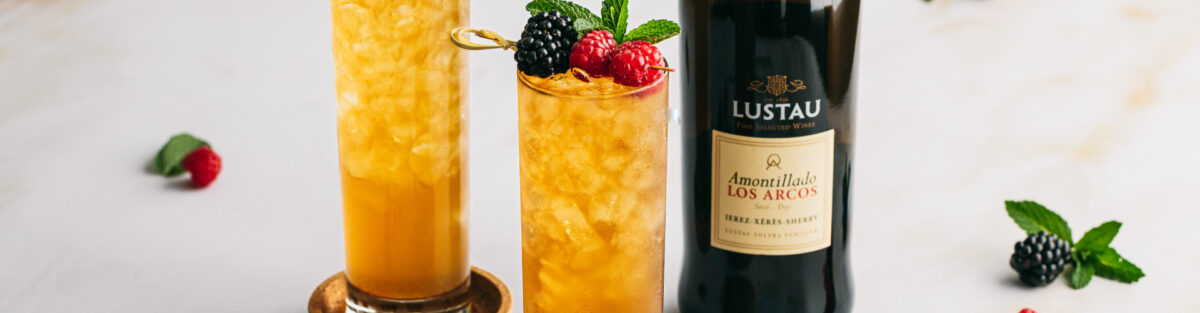






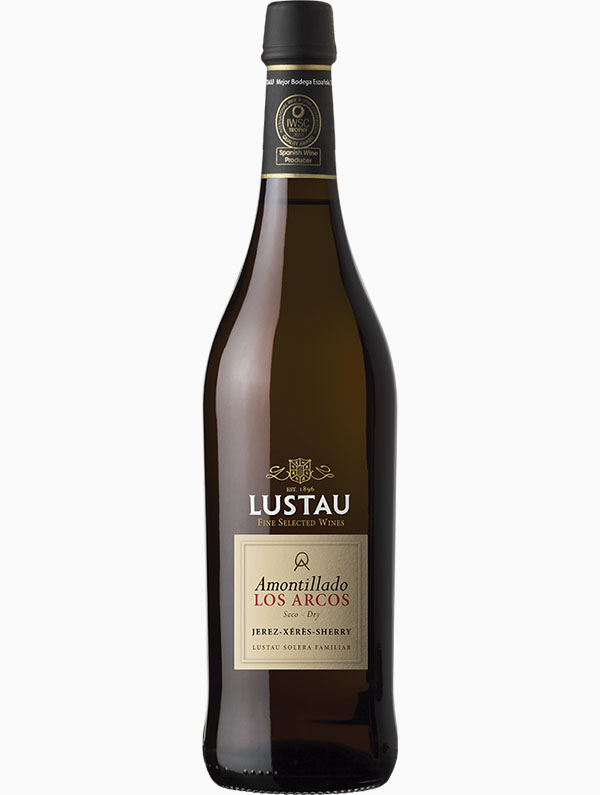
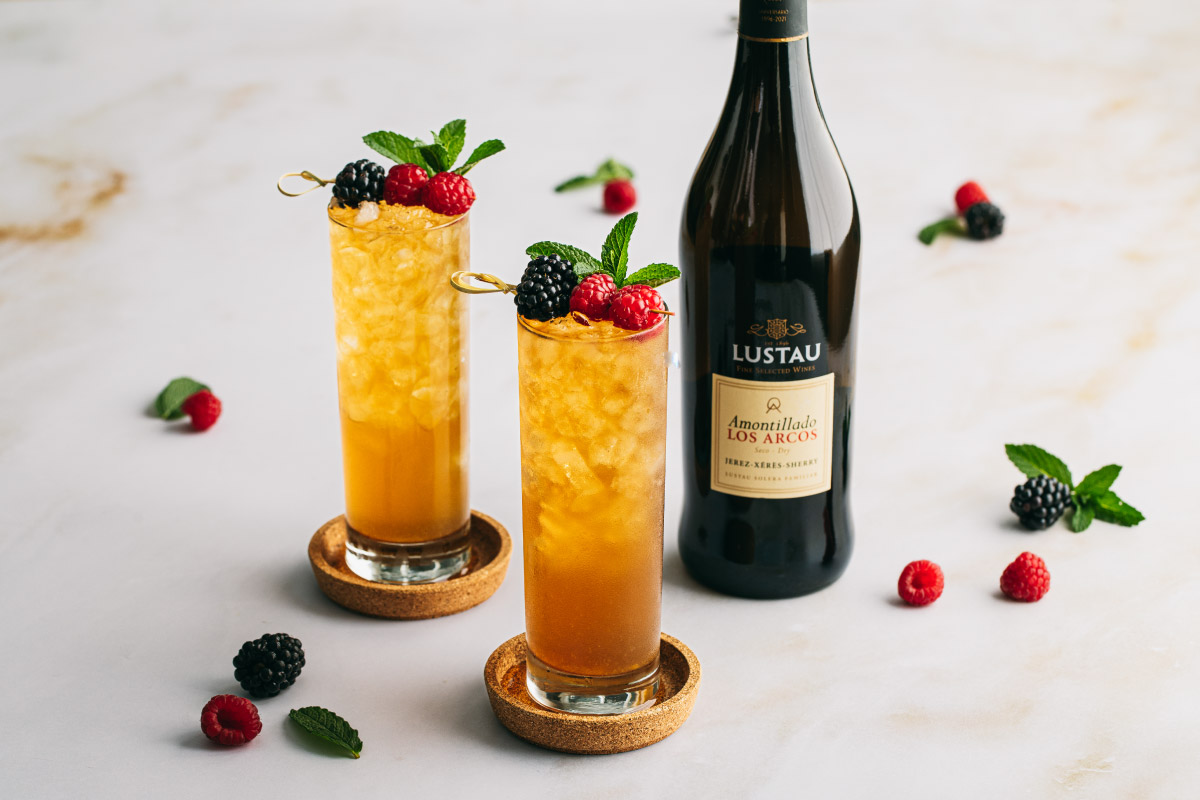
For a drink that often gets overlooked in today’s drinking culture, the Sherry Cobbler cocktail has an outsized claim on cocktail history. Built from a simple mix of sherry, sugar, and citrus, piled with crushed ice and sipped through a straw, the classic Sherry Cobbler was one of the most popular mixed drinks in the United States for much of the 19th century. It’s credited with popularizing the drinking straw, turning crushed ice into something worth showing off, and lending its name to an entire family of drinks bartenders still use today. Our Sherry Cobbler cocktail recipe calls for Lustau Amontillado Los Arcos as the base wine, which balances the salinity from its time as a biological aged wine with the nuttiness from its oxidative aging. Have a sip and discover why amontillado is the king of the cobbler.
COCKTAIL: Sherry Cobbler
Full Ingredients list
- 3 oz Lustau Amontillado Los Arcos
- .5 oz Simple Syrup
- 3 Orange Wedges
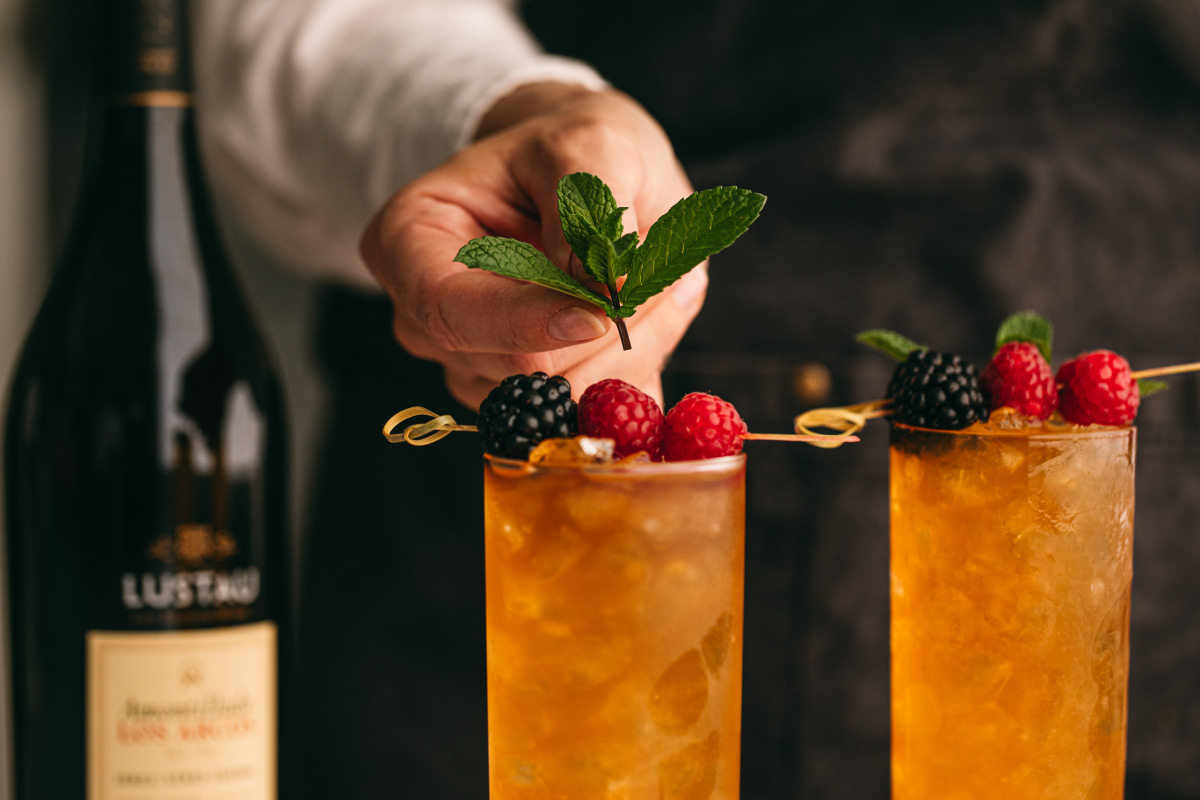
- Garnish: Mint Sprig, Lemon Wheel, Seasonal Berries
Recipe author: Steven Dragun
What is the history of the Sherry Cobbler?
Nobody recorded who first stirred sherry, sugar, and orange together over a heap of ice, but the timing lines up with a specific moment in American drinking habits. Through the 1810s and 1820s, the fashionable drink in American taverns had been the Mint Sling, an early relative of the Mint Julep. Sometime around the 1820s or early 1830s, the Sherry Cobbler arrived, and within a decade it had completely eclipsed the Mint Sling. The Sherry Cobbler might have remained an American regional curiosity if not for Charles Dickens. Dickens toured the United States in 1842 and, while he mostly used the trip to gently mock American manners, made a notable exception for one thing he’d genuinely enjoyed, a Sherry Cobbler.
The origin of the Sherry Cobbler in 19th-century cocktail culture
Cocktail historian David Wondrich traced the earliest known written reference of the drink to 1838, in the diary of Katherine Jane Ellice, the wife of a Canadian government official. Touring resorts in upstate New York, she tried the drink and pronounced it “delicious and easy of composition,” a review that still holds up two centuries later. The timing wasn’t a coincidence. Ice had only become a widely available commodity in American cities during the 1820s, part of a fast-growing domestic ice trade that cut blocks from frozen New England ponds each winter and shipped them, packed in sawdust, to cities up and down the coast. By 1841, ice could even travel by rail. A drink built entirely around a heap of crushed ice, in other words, could only exist once keeping things cold had become fashionable and practical, and the Sherry Cobbler put that novelty on full display in a tall glass, rather than tucking it away in a julep cup.
Why use Lustau Amontillado Los Arcos in a Sherry Cobbler cocktail recipe?
Lustau Amontillado Los Arcos is widely considered a benchmark for the classic Sherry Cobbler because it perfectly threads the needle between the biological and oxidative spectrums, providing the exact structural integrity needed to survive the cocktail’s heavy dilution. When you are building a drink that relies entirely on crushed ice and sugar, you are immediately fighting a battle against the base spirit washing out, and Lustau Amontillado Los Arcos counteracts this beautifully. At 18.5% ABV, Amontillado Los Arcos has the alcoholic backbone that biologically (such as fino or manzanilla) aged sherries lack. If you build a Cobbler with a standard 15% fino, the aggressive chill and rapid water release from the cobble ice will shatter the wine’s structure before the guest is halfway through the glass. The slightly higher proof of the amontillado ensures the drink remains texturally round and doesn’t thin out.
How Amontillado sherry changes the flavor of a classic Sherry Cobbler
When you use amontillado as the base for a Sherry Cobbler, you are fundamentally shifting the cocktail’s center of gravity from bright and sharp to savory and robust. Because amontillado undergoes two distinct aging processes, starting its life under a veil of “flor” before losing it and aging oxidatively, it introduces a dual flavor profile that interacts completely differently with the ice, sugar, and citrus compared to a purely biological or purely oxidative sherry.
Learn more about this veil of “flor” below:
Why Lustau Amontillado Los Arcos works in refreshing sherry cocktails
Lustau Amontillado Los Arcos serves as an indispensable tool for refreshing formats like spritzes, highballs, and cobblers. Its success in these long, ice-heavy drinks comes down to its specific structural and chemical composition. The transition from biological to oxidative aging makes it incredibly versatile in the glass. The biological memory, its residual acetaldehyde and salinity, provides the crisp, mouth-watering snap required for a patio-style crusher. Simultaneously, the oxidative notes of hazelnut, toasted wood, and faint caramel anchor brighter ingredients. This prevents citrus-heavy or soda-lengthened drinks from tasting thin, overly tart, or purely one-dimensional.
For more info on amontillado, check out the blogpost below:
What glass is best to serve a Sherry Cobbler cocktail in?
For most occasions, the standard 12-14oz (360-420ml) Collins or highball glass is the most reliable workhorse. The tall, narrow chimney shape serves a distinct purpose: it stacks the crushed ice beautifully, minimizing the surface area of the ice exposed to air compared to a wider glass. This helps control the dilution rate of the sherry, especially if you are working with an amontillado or oloroso that you want to keep tight. It also forces the garnish, like a mint sprig and citrus wheels, right under the drinker’s nose as they sip through the straw.
How to prepare a Sherry Cobbler with Lustau Amontillado Los Arcos at home
1. In a mixing tin, muddle the orange wedges and simple syrup.
2. Add Lustau Amontillado Los Arcos
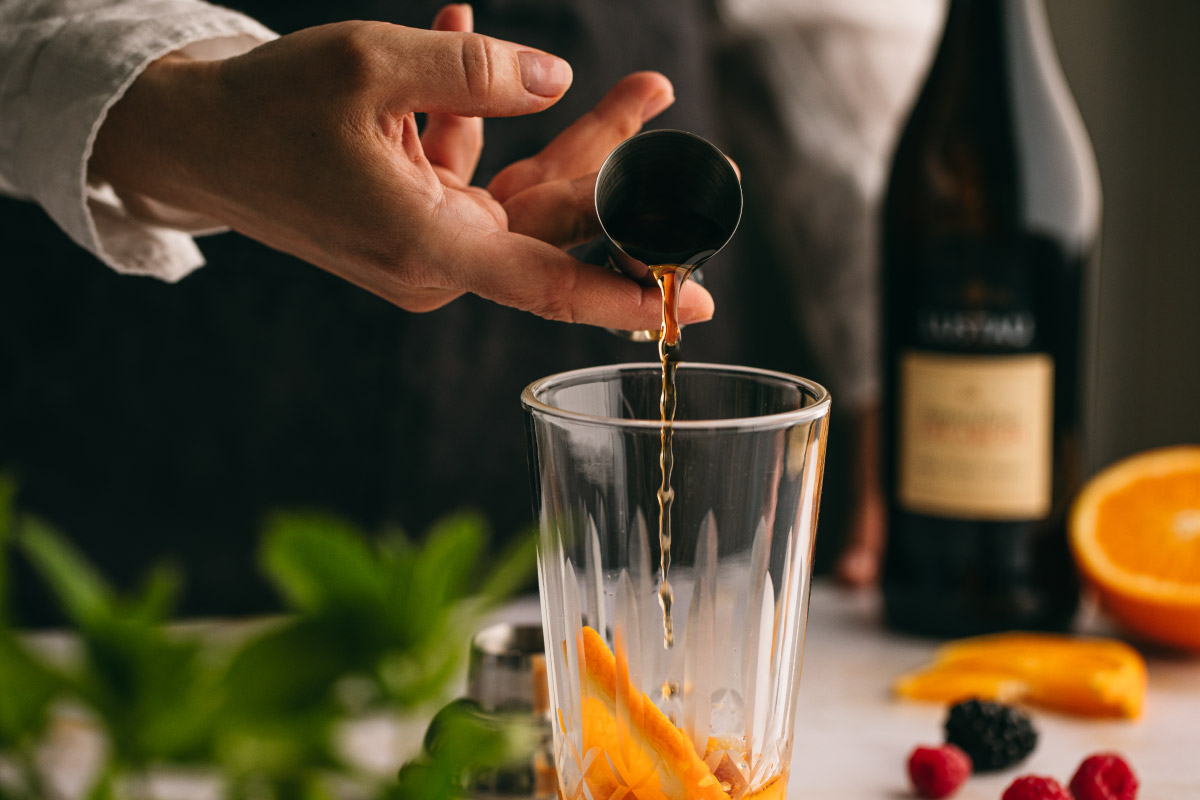
3. Add ice, shake, and strain into a Collins glass filled with crushed ice.
4. Garnish with mint sprig, lemon wheel, and berries
FAQ
What ingredients are in a Sherry Cobbler cocktail?
A classic Sherry Cobbler is a simple recipe of dry sherry, simple syrup, and muddled oranges. Today, one can find Sherry Cobblers with a blend of different sherries, fruits, liqueurs, and garnishes.
What is the difference between a Sherry Cobbler and other sherry cocktails?
The defining difference between a Sherry Cobbler and other Sherry cocktails lies in how the wine is treated. In a Cobbler, the Sherry is the undeniable star, dictating the entire structure of the drink. In most other classics, Sherry acts as a modifier, a supporting player meant to lengthen, dry out, or add savory depth to a stronger base spirit.
Get access to our full cocktail library here:
Why is the Sherry Cobbler cocktail called a cobbler?
The name “cobbler” comes from the “cobbles”, a term that reflects the cobblestone roads of the day, of ice used to make the drink. Because the Sherry Cobbler relied entirely on that mountain of ice to rapidly chill and dilute the fortified wine, the visual of the “cobbled” ice became the drink’s defining physical feature.
What type of sherry is best for a Sherry Cobbler cocktail?
Amontillado is widely considered the gold standard for a classic Sherry Cobbler, though the “best” choice depends entirely on how much weight and oxidation you want to bring to the glass.
Can you make a low alcohol Sherry Cobbler cocktail?
While the classic Sherry Cobbler is already the historical benchmark for a low-ABV cocktail, you can push the alcohol content even lower without sacrificing the drink’s structural integrity. By replacing half the sherry with a heavy, amaro-adjacent non-alcoholic spirit, you maintain the mouthfeel and complexity while dropping the total cocktail ABV to around 7% pre-dilution.
For more information regarding no and low ABV cocktails, check out the link below: